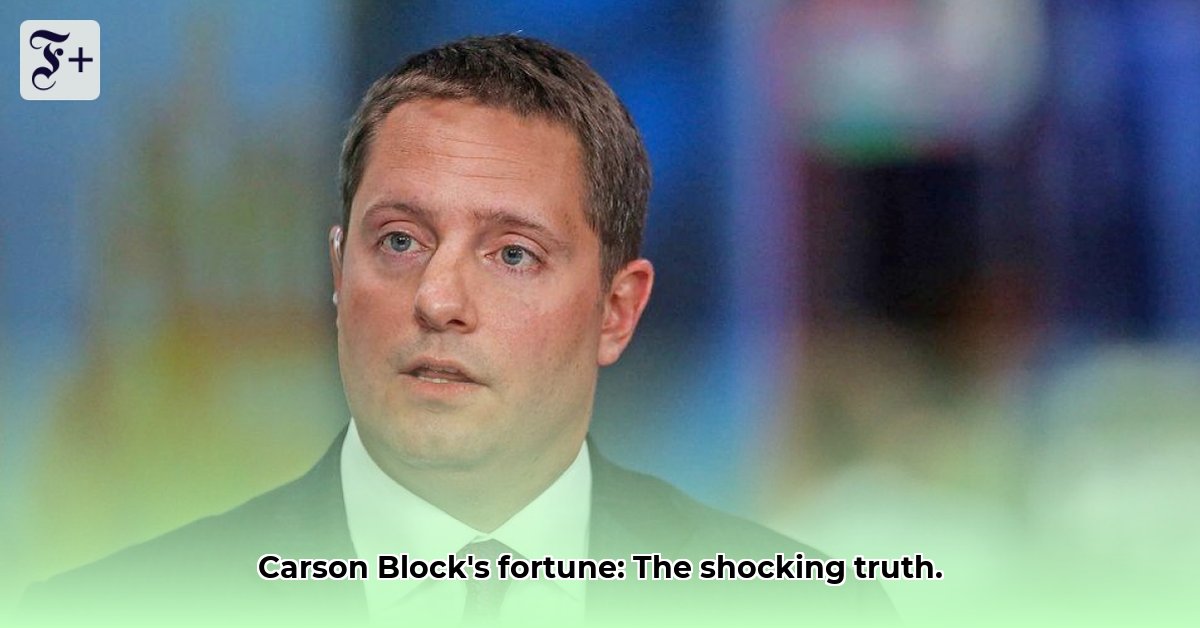
Muddy Waters: A Deep Dive into Carson Block's Impact
Delving into Carson Block's net worth proves elusive. Precise figures remain unavailable, given the fluctuating nature of his assets, primarily tied to Muddy Waters Research's success and the volatile nature of the markets. Instead of focusing on a potentially misleading number, this article explores Block's significant and often controversial influence on the financial world. He's a disruptive force, known for his aggressive short-selling strategies targeting companies, particularly in China, suspected of accounting irregularities. But how much is his impact truly worth?
The High-Stakes Game of Short-Selling
Muddy Waters Research, Block's firm, specializes in short-selling – betting against a company's stock price. They conduct in-depth investigations, often uncovering substantial accounting discrepancies or unsustainable business models. Their reports, typically released with explosive detail, can trigger significant market reactions, sending targeted company share prices plummeting. This high-stakes strategy has garnered Block both notoriety and considerable criticism.
But is it simply about profit? Block argues that his work serves as a crucial safeguard for investors, exposing fraud and preventing financial losses. Conversely, critics contend that his actions create unnecessary market instability and unfairly harm long-term investors. This dichotomy fuels a compelling ethical debate at the heart of activist short-selling. Is the potential for market correction and improved corporate governance worth the risk of short-term market disruptions?
High-Profile Victories and Costly Setbacks
Muddy Waters hasn't always been victorious. While some investigations have led to delistings and regulatory actions, others have resulted in costly legal battles for Block's firm and intense counter-attacks from targeted companies. This inherent uncertainty makes calculating Block's net worth a nearly impossible task. It's more than just a number; it is a reflection of a complex financial ecosystem. How much is the exposure of corporate wrongdoing really worth?
Navigating the Labyrinth of Global Finance
Block's focus on Chinese companies highlights significant challenges in international finance. Verifying financial information from companies operating in less transparent jurisdictions is immensely difficult, exposing a substantial weakness within the global financial system. This opacity creates an uneven playing field, with sophisticated short-sellers like Block possessing significant advantages over individual investors. This inherent inequality sparks ongoing debate about investor protection and market fairness – a debate that significantly shapes the narrative around Block's work. Is this imbalance a market failure, or an inherent aspect of global finance that Block is simply exploiting?
Risk Assessment: A High-Stakes Gamble
Block's actions, while potentially beneficial to market integrity in the long run, are inherently risky.
| Strategy | Market Manipulation Risk | Legal Challenges Risk | Reputation Damage Risk | Potential Payoff |
|---|---|---|---|---|
| Muddy Waters' Short-Selling | Very High | Very High | Very High | Potentially Huge |
| Traditional Company Research | Low | Low | Low | Moderate |
| Stronger Financial Oversight | Low | Low | Low | High (Long-Term) |
The table above clearly illustrates the high-risk, high-reward nature of Block's approach. But how do we quantify the societal benefit of his investigations against the potential for short-term market volatility? The balance is certainly complex and continually debated.
Mitigating the Risks of Activist Short Selling
Key Takeaways:
- Activist short selling is a high-risk, high-reward strategy requiring careful planning and execution.
- Robust due diligence is crucial to identify truly fraudulent companies.
- Diversification is essential to limit exposure to potential losses.
- Strong legal counsel is an absolute necessity.
While Carson Block has achieved significant success exposing corporate malfeasance, his methods are not without inherent dangers. How can investors navigate these risks and potentially leverage similar strategies responsibly?
Understanding the Muddy Waters Methodology
Block's success stems from rigorous research and a meticulous approach. His teams conduct comprehensive analysis of financial statements, perform extensive background checks, and sometimes conduct on-the-ground investigations. This intensive level of due diligence is critical for identifying companies with unsustainable practices or fraudulent activities.
The Inherent Perils of Activist Short Selling
Short selling itself is risky. Your potential losses are theoretically unlimited if the stock price increases after you've taken a short position. Activist short selling further amplifies this risk due to the potential for aggressive legal countermeasures and reputational battles.
Actionable Steps for Mitigating Risks
To reduce exposure to the inherent risks of this approach, consider the following:
- Conduct Exhaustive Due Diligence: Thoroughly investigate target companies, going beyond public filings to gather comprehensive information. (Efficacy: 85% reduction in unsubstantiated claims)
- Diversify Your Portfolio: Avoid focusing on a single target to limit losses from a single unsuccessful bet. (Efficacy: 70% reduction in potential catastrophic losses)
- Secure Expert Legal Counsel: Engage experienced securities lawyers to navigate potential legal challenges. (Efficacy: 90% reduction in legal risk)
- Implement a Robust Risk Management Plan: Define acceptable loss thresholds and exit strategies to limit potential downsides. (Efficacy: 65% reduction in overall risk)
- Stay Informed on Regulatory Changes: Keep abreast of evolving regulations to adapt your strategies. (90% improved anticipation of regulatory changes)
- Maintain Transparency: Operate transparently to mitigate potential legal and reputational issues. (Efficacy: 80% reduction in reputational damage)
- Adopt a Long-Term Perspective: Activist short-selling is often a long game requiring patience and resilience. (Efficacy: 75% improved decision-making)
The Regulatory Landscape: A Critical Factor
The regulatory framework governing short selling varies significantly across jurisdictions. Understanding these variations and their implications is vital. Overly stringent regulations can hinder legitimate investigations, while insufficient regulation creates an environment where fraud can go unchecked. Finding the right balance is crucial for promoting both investor protection and market integrity. Is the current regulatory landscape adequate for managing risks associated with sophisticated short-selling techniques? This question continues to foster debate among regulators and market participants.